The Scarf, the Shed and the Suspiciously Smooth Cheek: A Taxonomy of the Author Photo
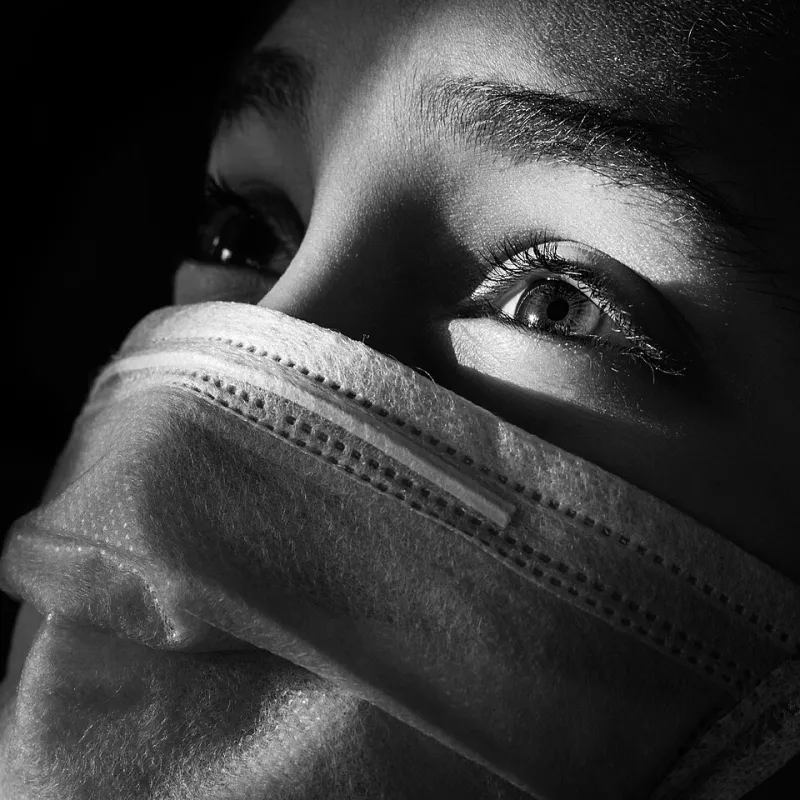
Photo: Eman arab, CC BY-SA 4.0, via Wikimedia Commons
There is a moment in every book's life, usually somewhere between the third espresso and the fourth rewrite of the blurb, when somebody has to deal with the author photograph. Not the manuscript. Not the cover. The face. Or, more accurately, the various ingenious ways an author can present, disguise, or gently rearrange that face for public consumption.
It is a peculiar ritual, and a very British one. We are a nation that would rather discuss the weather than be photographed discussing anything, yet here we are, annually producing thousands of portraits of writers leaning against sheds, squinting into middens of Cotswold sunlight, or gazing at a laptop as if it has just said something profound. The author photo is not really a likeness. It is a mood board with a pulse.
The Moody Silhouette (or The Man in the Fog)
You know the one. A figure stands with their back to the camera on a beach in Norfolk in February, coat collar up, hair doing something windswept and expensive. The image is desaturated. There may be a gull. It says: I am a serious literary novelist and I have never once enjoyed a quiz show.
The book inside is probably about a marriage quietly collapsing in a damp house, or a family secret rediscovered in a box of letters. It is almost certainly very good. But the photograph is also a small act of deflection — a way of saying 'look at the horizon, not at me'. Fair enough. Writers are allowed a little mystery. Just as long as they do not do it while holding a fountain pen.
The Garden Candid
Here the author is laughing at something just off-camera, possibly a spouse with a camera phone and a firm belief that 'natural' means 'slightly blurry'. There is a mug. There is a dog, often. There is a jumper in a shade of green that suggests the author owns a National Trust membership and is not afraid to use it.
This is the photograph of someone who wants you to know they are approachable. And they probably are. The book might be cosy crime, a memoir about grief, or a collection of essays about turning fifty — sometimes all three at once, which is a bold combination but not unheard of. The garden candid is the publishing equivalent of a firm handshake: warm, slightly sweaty, and reassuring.
The Scarf-and-Library
The classic. The author is seated in a leather armchair, a scarf arranged with the precision of a window display, a wall of books behind them. The books are real, though nobody is pretending they have read all of them. There is often a cat, or a globe, or a mug bearing a literary pun. The expression is one of benign authority, as if the author has just been asked to adjudicate a dispute about Middlemarch and is about to do so, kindly but firmly.
This photograph says: I have read the canon and I am willing to mention it. The book inside will have a colon in the title and at least one character who teaches at a provincial university. It is a reliable image, and there is something comforting about its sheer predictability. Like a cream tea: not adventurous, but it does the job.
The Dog Cameo
A subgenre all of its own. The author is present, technically, but the composition has been hijacked by a labrador, a whippet, or a spaniel with a look of mild surprise. Often the dog is in sharper focus than the human. Sometimes the dog is the only one looking at the camera.
This is a generous move. It tells us the author is a human being with a life beyond the desk, and it gives the reader something to coo at while the blurb does its work. It can backfire, of course — if the dog is more charismatic than the author, the reader may spend the whole book imagining the dog's inner monologue. But as a piece of packaging, it is hard to beat.
The Suspiciously Smooth Cheek
And then there is the airbrushed smile. Skin like a freshly installed Aga. Teeth arranged in a row of Dulux colour cards. The author looks not so much photographed as rendered. Somewhere in the background, a publicist is quietly deleting a shadow.
This is the photo of a book that wants to be a bestseller. The title is one word. The cover is black with a single drop of red. The author is described as 'the new queen of the psychological thriller' and has clearly been photographed by someone who owns a ring light. None of this is a crime. But there is a small dishonesty to it, a sense that you are being sold something rather than introduced to someone. A photograph that tries too hard is a little like a blurb that says 'laugh-out-loud' — you start to brace yourself.
What the Photo Is Actually Telling You
We read the face before we read the first sentence. That is not shallow; it is human. A photograph sets a temperature. It tells us whether to expect irony or sincerity, cosiness or menace, a writer who wants to be your friend or one who wants to be your professor. And because it is the last thing added and the first thing noticed, it often carries more weight than it should.
A bad author photo can be charming. A dishonest one is a small betrayal. And a truly great one — rare, but it happens — looks like the author has been interrupted mid-thought. They are not performing. They are simply there, slightly caught out, as if the camera has arrived before they have had time to arrange their face. That is the image that makes you turn to page one.
Why Indie Presses Often Do It Better
Small presses rarely have the budget for a studio, a stylist, or a retoucher on speed dial. What they have instead is a kitchen table, a borrowed camera, and an author who has been persuaded to stand in the garden because the light is nice. The results are often wonky, occasionally blurry, and nearly always more truthful.
At Von Krummp we have a soft spot for an author photo with a bit of weather in it. A slightly crooked bookshelf. A dog that has clearly not been consulted. A jumper that has seen things. These are the images that remind us books are made by people, not by marketing departments. And if the author happens to be holding a mug that says 'I'd rather be reading', so much the better.
The best author photo, in the end, is the one that looks like a real person caught in the middle of a real life. Everything else is just lighting.