Shelves of One’s Own: A Modest Manifesto for the Gloriously Unsortable Bookcase

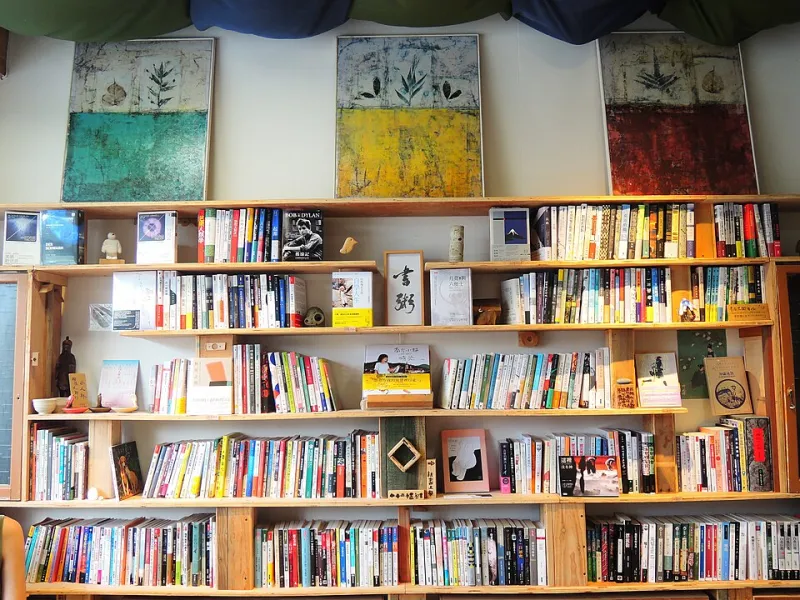
Photo: cosy cluttered bookshelf with mismatched books in a British home, via img.republicworld.com
There is a particular kind of British bookshelf that looks as if it has been styled by a committee of interior designers and a stern librarian. Books are arranged by colour. Spines face outward with military precision. There is a fern. It is beautiful, and it tells you nothing about the person who owns it except that they own a spirit level.
I am not against beauty. I am against the idea that a home library must behave itself. A bookshelf is not a filing cabinet with pretensions; it is a portrait, and portraits are more interesting when the subject has a crooked nose. The shelves I trust are the ones arranged by mood, memory and sheer bloody-mindedness — the ones where a 1970s paperback of Iris Murdoch is wedged next to a guide to keeping chickens because both were bought on the same rainy Tuesday in Hay-on-Wye.
The tyranny of the tidy shelf
We have been sold a lie about bookshelves. The lie is that a shelf should be a system. Alphabetical by author. Chronological by publication. Colour-blocked by hue, as if your Penguin Classics are a set of paint swatches. These schemes are magnificent in bookshops, where strangers need to find things, and in photographs, where nobody needs to find anything at all.
At home, a shelf has a different job. It has to hold the books you meant to read, the books you have read, the books you claim to have read, and the books you keep because a friend wrote them and you love the friend more than the book. It also has to hold the book you bought because the cover was orange and you were in a hurry. No alphabetical system can accommodate that kind of honesty.
The mood shelf is the most human arrangement of all. There is a shelf for books that feel like winter. A shelf for books that feel like a bad decision in a good way. A shelf for books you reach for when you cannot sleep, and a shelf for books you reach for when you need to remember why you like people. The shelving is not random. It is emotional metadata.
A field guide to the gloriously unsorted shelf
Every home library develops its own local customs. Here are a few specimens I have encountered, usually while looking for a corkscrew.
The Toppling Pile. Not technically a shelf. More of an architectural aspiration. It begins with three books and ends with a small landslide near the radiator. The Toppling Pile is a sign of a reader who is optimistic about time and pessimistic about gravity.
The Shame Corner. These are the books you feel you ought to have read. They are usually hardbacks, usually serious, and usually watching you. My copy of Middlemarch has been staring at me since the coalition government. I have moved it three times and dusted it twice. It has never once blinked.
The Borrowed-and-Never-Returned Shelf. Every reader has one. It is not exactly a shelf; it is a diplomatic incident in paperback form. A copy of Captain Corelli’s Mandolin that has been on tour since 2003. A friend’s cookbook with a bookmark still at the recipe for something nobody made. You do not return these books because returning them would require admitting that you have had them for two decades, and at this point it is kinder to everyone if they simply become part of the furniture.
The Mood Shelf. A small, volatile collection that changes with the weather. After a breakup it is all poetry and revenge. After a promotion it is all business books and delusion. After a bad week it is exactly one novel by Alan Bennett and a biscuit.
The Shelf of Good Intentions. These are the books on improving yourself. They sit near the desk and radiate quiet disappointment. You bought them in January. It is now November. They have become part of the stationery.
What a messy shelf actually says about you
A chaotic shelf says that you are a reader, not a curator. It says that books have entered your life at different times and for different reasons, and that you have not had the heart to impose a regime on them. It says that you have a memory. The book from the holiday in Cornwall is next to the book from the hospital waiting room because that is where they belong in your head, even if not in anyone else’s spreadsheet.
There is also a practical argument. A shelf arranged by instinct is easier to browse. You do not go looking for a specific book; you go looking for a feeling, and the feeling is usually somewhere near the middle, slightly to the left, behind the dictionary. The dictionary is there because it was your grandmother’s, and the shelf knows that.
At Von Krummp we are obviously fond of curious minds and quirky books, but we are equally fond of the homes those books end up in. A perfectly styled shelf is a shop window. A slightly crooked shelf is a life. It has a coffee ring on it. It has a train ticket used as a bookmark. It has one book facing the wrong way because the spine is ugly and you love it anyway.
So let the shelf be crooked. Let the poetry lean on the cookery. Let the thriller sulk next to the self-help. If anyone asks whether your books are arranged in a system, you can tell them the truth: yes, by mood, memory and sheer bloody-mindedness. Then offer them a biscuit and change the subject.