Nine Lives Behind the Counter: A Field Report on Britain’s Bookshop Cats
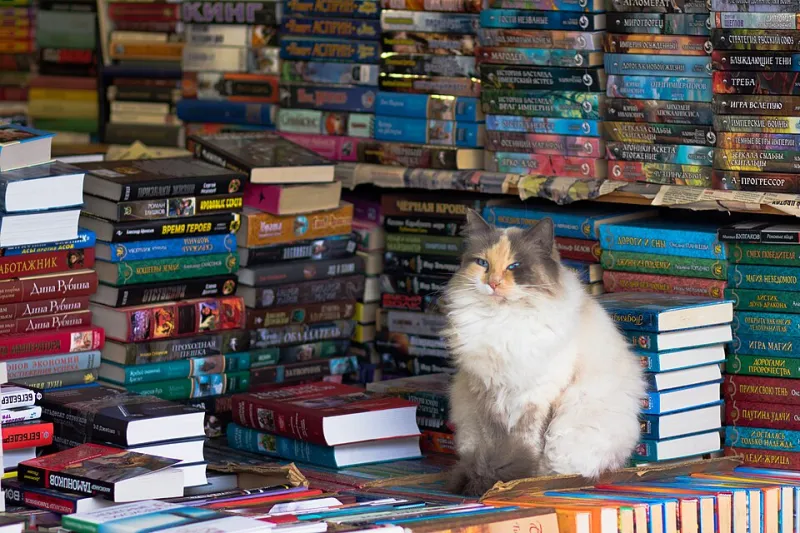
Photo: Alexey Komarov, CC BY-SA 4.0, via Wikimedia Commons
Somewhere between the true-crime shelf and the travel section, a cat is asleep on a stack of hardbacks. This is not an accident. It is a public service.
Earlier this autumn, Von Krummp Publishing dispatched me — armed with a notebook, a pocketful of biscuits and no statistical training — to conduct the Great British Bookshop Cat Census. The methodology was simple: walk into bookshops, ask if they had a cat, and then spend an unnecessarily long time watching it. The sample is biased, the response rate is governed by naps, and the margin of error is roughly one tail. It is, in other words, the most honest survey British retail has ever produced.
A Census With No Methodology Whatsoever
The plan was to catalogue feline shelf-patrol officers from Hay-on-Wye to Hebden Bridge. In practice, it became a tour of Britain’s most comfortable bookshops, conducted at the pace of a cat deciding whether to move. Some shops had no cat. Some had a cat who was technically retired. One had a cat who was, according to the bookseller, ‘more of a consultant’. All of them had opinions about where a cat should sit, and most of those opinions were ‘on the books’.
What follows is not a rigorous study. It is a field report from the front line of independent bookselling, where a warm patch of stock and a cardboard box can outrank any marketing budget.
The Crime Section Sleeper
At a second-hand shop in Suffolk, the resident cat — a broad-shouldered tabby with the expression of a man who has seen too much — has claimed the crime shelf. He sleeps on the Agatha Christies, wakes briefly for a streaky bacon sandwich, and then returns to his post. The bookseller told me, ‘He has solved more cases than our entire crime section combined. Mostly by sitting on them.’
Customers have learned to browse around him. Some ask whether the cat comes with the book. One regular brings a small blanket in winter, which the cat accepts with the graciousness of a minor aristocrat receiving a damp flannel. The shelf may be alphabetical, but the cat is not. He is categorical.
The Poetry-Shelf Tyrant
In a poetry specialist in Bristol, a slim black cat has annexed the shelf between Larkin and Heaney. She does not move for customers. She does not move for the till. She once refused to move for a delivery of new stock, and the bookseller simply built around her. ‘She has strong views on free verse,’ I was told, ‘and an even stronger view on being lifted.’
This cat is not a mascot. She is a critic. Shoppers lower their voices, reach past her with exaggerated care, and buy more poetry than they intended, largely to avoid disturbing her. It is the most effective upselling I have ever witnessed, and she has never once recommended a title.
The Till-Side Diplomat
A bookshop in York employs a ginger cat of considerable diplomatic skill. He greets customers at the door, inspects bags, and sits on the card machine whenever a transaction takes too long. His bookseller described him as ‘the only member of staff who has never been asked to check the stockroom’. A man came in for a map and left with three novels and a cat hair on his coat. That is conversion.
The till-side cat is the public face of the operation: calm, faintly judgemental, and entirely uninterested in the Booker list. He is also, crucially, a reason to linger. And a customer who lingers is a customer who browses.
What the Cats Actually Tell Us
A shop cat is a living shelf-talker. It cannot be bribed by publishers, quoted in a catalogue, or persuaded to pretend that a celebrity memoir is a work of quiet genius. It judges a shop by comfort, warmth and the availability of a suitable box. In doing so, it tells customers something true: this is a place run by humans who notice small things.
That matters. A bookshop cat is not a gimmick if it is cared for properly. It is a signal that the shop has a pulse. Visitors who came in solely to see the cat often leave with a book. Children learn to move quietly around stock. Adults learn to move quietly around each other. The cat, meanwhile, learns nothing and remains employed.
The Official(ish) Census Form
For future fieldworkers, I propose the following highly unofficial record:
- Name of officer: ______________________________
- Rank: Crime-section sleeper / poetry-shelf tyrant / till-side diplomat / consultant.
- Preferred patrol route: crime, poetry, travel, local history, or the vertical stack of remaindered cookbooks.
- Sleep-to-supervision ratio: ____ hours asleep to ____ minutes of active shelf management.
- Response to customers: ignore / stare / ankle rub / sit on bag / audible sigh.
- Special skill: knocking pens under shelving; appearing in photographs; shredding a receipt with dignity.
- Bookseller testimony: ________________________________________________.
- Verdict: Good cat / excellent cat / management.
The Case for the Shop Cat
Not every bookshop can or should have a cat. Allergies, food hygiene, lease agreements and the cat’s own temperament all matter. A miserable shop cat is worse than no shop cat at all. But where it works, the resident feline is the most honest browsing ambassador a bookshop can have. It does not upsell. It does not pretend to have read the reviews. It simply occupies the shop as if books and people belong together.
Anyone who has stroked a cat while deciding between two novels knows this is powerful retail theatre. The census will continue next autumn, assuming the officers wake up. In the meantime, if you find a cat on the crime shelf, do not move it. It is probably working.