A Village Hall Full of Nervous Strangers: Notes from the British Author Signing
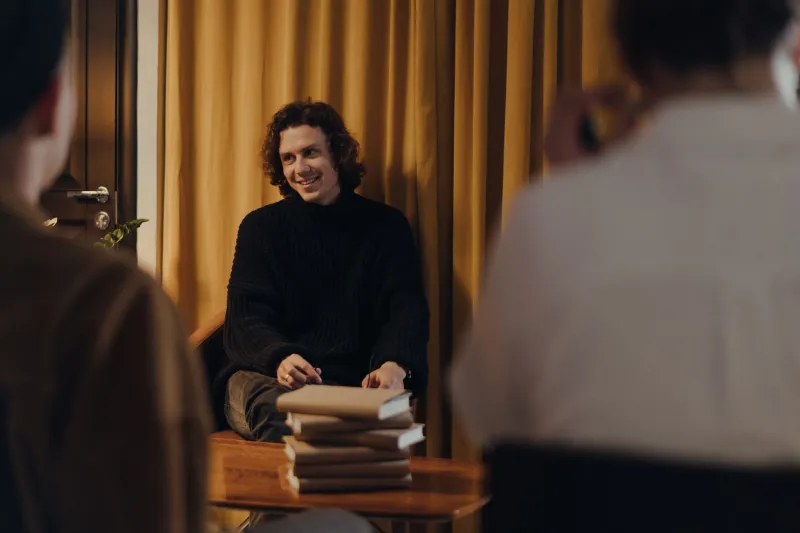
Author signings are strange theatre. A bookshop clears a corner, arranges chairs in a hopeful semicircle and places a small table at the front with a glass of water and a pen that may or may not work. The author arrives, looking either delighted or mildly hunted. The readers arrive, clutching books like passports. And somewhere between the first nervous hello and the last signed title, a peculiar British ritual unfolds: part literary event, part village fete, part group therapy for people who have forgotten the plot.
I have queued at these things. I have watched booksellers nudge each other behind the till. I have seen an author sign a book for a reader who then confessed she had not actually read it, only bought it because her sister said it was good. The author nodded with the magnificent grace of someone who has heard this before and will hear it again. It was, in its way, rather beautiful.
The Queue Is the Event
Every signing has a queue, and every queue has a personality. Sometimes it is a tidy line of patient people who have brought their own tote bags. Sometimes it is a loose shoal of readers drifting around the crime section, pretending not to be checking how fast the line is moving. The queue is not merely admin. It is the warm-up act.
Good queue etiquette is simple. Have your book open at the title page. Do not ask the author to sign six books for six cousins unless you have warned the bookseller in advance. Do not spend four minutes explaining your own novel idea while the line behind you quietly calcifies. And if you are going to take a photograph, please decide which pocket your phone is in before you reach the table. The author will wait. The queue will not.
Booksellers, meanwhile, become air-traffic controllers. One told me she keeps a stash of sticky notes by the signing table so readers can write their names in advance. It speeds things up, prevents spelling disasters and gives the author something to look at besides a stranger's expectant face. A Sharpie, she added, is better than a fountain pen for a quick signature, but a fountain pen makes the whole thing feel more like a coronation. There is no right answer. There is only ink.
What to Say When You Have Forgotten the Plot
This is the great unspoken crisis of the author signing. You loved the book. You know you loved the book. You recommended it to at least two people. But now, standing in front of the person who wrote it, your mind has become a municipal car park at dusk. Nothing is there. Not a character, not a twist, not even the title on the cover in your hands.
You have options. The honest approach is underrated: 'I'm sorry, my brain has gone completely blank, but I did enjoy it enormously.' Authors tend to like this. It is direct, human and does not require them to perform delight at a plot summary that is technically about their own novel but somehow sounds like a different one entirely.
Other approaches include the broad compliment ('The atmosphere was wonderful'), the safe question ('How long did it take you?') and the risky gambit of mentioning a character you may have invented. I once heard a reader say, with tremendous confidence, 'I loved the bit with the dog.' The author paused. There was no dog. To her eternal credit, she signed the book and said, 'The dog was cut in the final draft.' The reader left happy. The queue left inspired.
The Strange Economics of the Signed First Edition
A signed first edition occupies a peculiar place in the British imagination. It is not quite an investment, not quite a souvenir, and not quite a book you can comfortably read in the bath. It sits on a shelf with a small piece of paper tucked inside explaining why it should not be exposed to direct sunlight. It is a financial instrument made of paper and hope.
Booksellers speak of the signed first edition with affection and caution. A signature can add value, but it can also add admin. Was the book signed before or after publication? Was it a tipped-in page? Is the author still signing, or has the pen been permanently capped? One bookseller in the north of England told me he once had a customer ring to ask whether a signed copy would go up in value if the author 'became more famous or, you know, died'. He said he replied that he was not a financial adviser and suggested she buy it because she liked it. She bought it anyway. The signature, he suspected, was the point.
This is the quiet truth of the signing table. Most readers are not investors. They are people who want a small physical proof that they were in the same room as the voice that kept them company. The economics are strange because the value is emotional. A Sharpie squiggle on a title page can turn a paperback into a relic. It can also make a bookseller sigh softly at the till.
A Tongue-in-Cheek Taxonomy of the Signing Line
The Collector arrives with a bubble-wrapped hardback and a list of questions about print runs. The Apologiser begins every sentence with 'Sorry, this is probably a silly question.' The Plot Blurter recounts the entire novel back to the author, sometimes accurately. The Relative explains that she has not read the book but her daughter has, and the daughter is currently parking the car. The Sticky Note Strategist has written the dedication in advance, including punctuation, and watches the pen closely. The Quiet Devotee says almost nothing, then beams. The Person Who Brought a Different Book is a beautiful chaos agent, and the author signs it anyway because what else can you do?
And then there is the Hugger. Not every signing has one, but every bookseller remembers one. The Hugger approaches the table with open arms, having decided that the author's novel was a personal letter addressed to them. The author, who has been sitting down for an hour and is thinking about tea, must make a split-second decision about bodily autonomy, British reserve and the line of people watching. The result is the awkward hug: half embrace, half pat, entirely memorable. It is not to be encouraged. It is, however, very British.
Why the Village Hall Beats the Lecture Theatre
The best signings do not feel like lectures. They feel like village halls: slightly too warm, faintly echoing, with a table of biscuits at the back and a raffle nobody quite understands. The author is not elevated on a stage. They are simply there, in a cardigan, signing books for people who have made a special trip. The atmosphere is ordinary in the best way. It says: literature belongs to everyone, and everyone has brought a bag.
So if you are going to a signing in 2026, go early, bring your book, prepare one honest compliment and do not panic if you have forgotten the plot. The author probably has too. The bookseller is watching the queue, the Sharpies are ready and the awkward hug is always a possibility. It is not a perfect system, but it is ours, and it smells faintly of paper and radiator dust.